A buyer's guide to wooden box hardware
Hinges, magnets, locks, clasps, pulls — the small parts that decide how a box opens, closes, and feels in the hand. Plus what to upgrade and what to skip.
On this page
Hardware is the part of a wooden box buyers think about last and feel first. Wrong hinge and the lid sags after six months. Right magnet and the box snaps shut with that satisfying premium thunk that sells the unboxing.
Yet most spec sheets we receive treat hardware as an afterthought — a single line saying "brass hinges" or "magnetic closure" with no specification of grade, finish, mounting style or operation type. The result is boxes that look fine in renderings and feel mediocre in hand.
This guide covers every type of hardware we install in production wooden boxes, with specific recommendations on what to upgrade, what to skip, and how to specify properly to avoid the silent quality drift that happens when hardware decisions are left to the factory.
Hinges — the most-noticed hardware
Hinges are the hardware customers interact with every time they open the box. A bad hinge wears the wood, twists the lid, or fails entirely after a few hundred cycles. A good hinge lasts the life of the box.
Surface-mount brass hinges
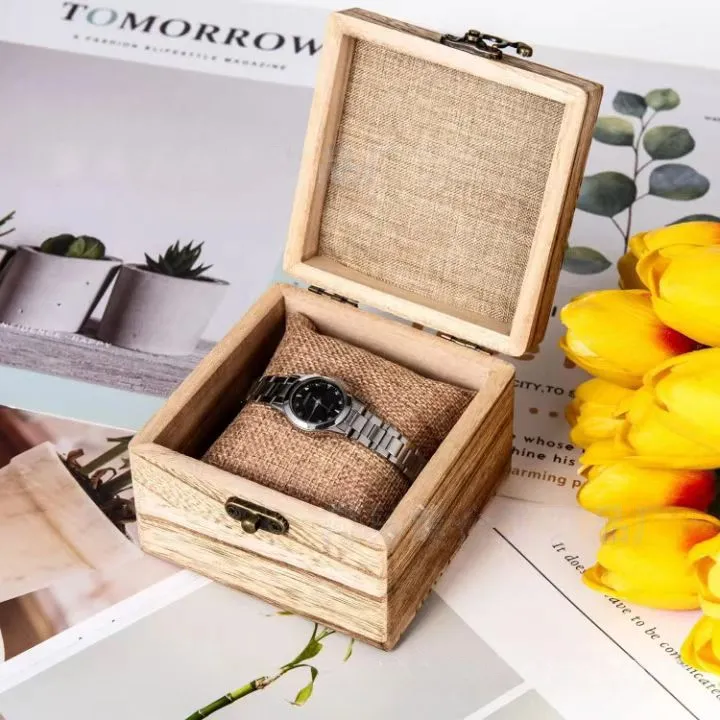
Visible brass hinges screwed to the back of the lid and box. Traditional, immediately readable, available in polished brass, antique brass, satin brass and matte black. Best for vintage gifting, heritage-style jewelry boxes, and anything with a "classic" voice.
Cost: $0.18-0.45 per pair depending on size and finish.
Concealed European hinges
Hidden inside cup-shaped recesses cut into the box and lid. Exterior is clean — no visible hardware. Premium feel, modern look. Standard for high-end watch and jewelry boxes.
Cost: $0.40-0.95 per pair. Add $0.20 for soft-close mechanism (highly recommended for premium boxes).
Piano hinges (full-length)
A single hinge running the full length of the lid. Maximum structural integrity, distributes load, lid cannot twist. Best for large boxes, heavy lids, or boxes that will be opened and closed thousands of times (humidors, tool chests, retail counter cases).
Cost: $0.55-1.40 depending on length.
Strap hinges
Decorative L-shaped or T-shaped hinges that extend visually onto the lid surface. Heritage / rustic look. Common on wine boxes and farmhouse-style gifting.
Cost: $0.30-0.70 per pair.
Magnetic closures
Hidden neodymium magnets routed into the wood wall produce that satisfying "click" when the lid closes. Strength is calibrated by magnet grade and quantity — too weak and the lid pops open in transit, too strong and the box is hard to open one-handed.
Standard grades:
| Grade | Pull Strength | Best Use |
|---|---|---|
| N35 | Light | Small lid boxes, cosmetics packaging |
| N42 | Medium | Standard gift boxes, tea boxes (default) |
| N48 | Strong | Larger boxes, multi-watch cases |
| N52 | Very strong | Large lift-off lid boxes, premium gifting |
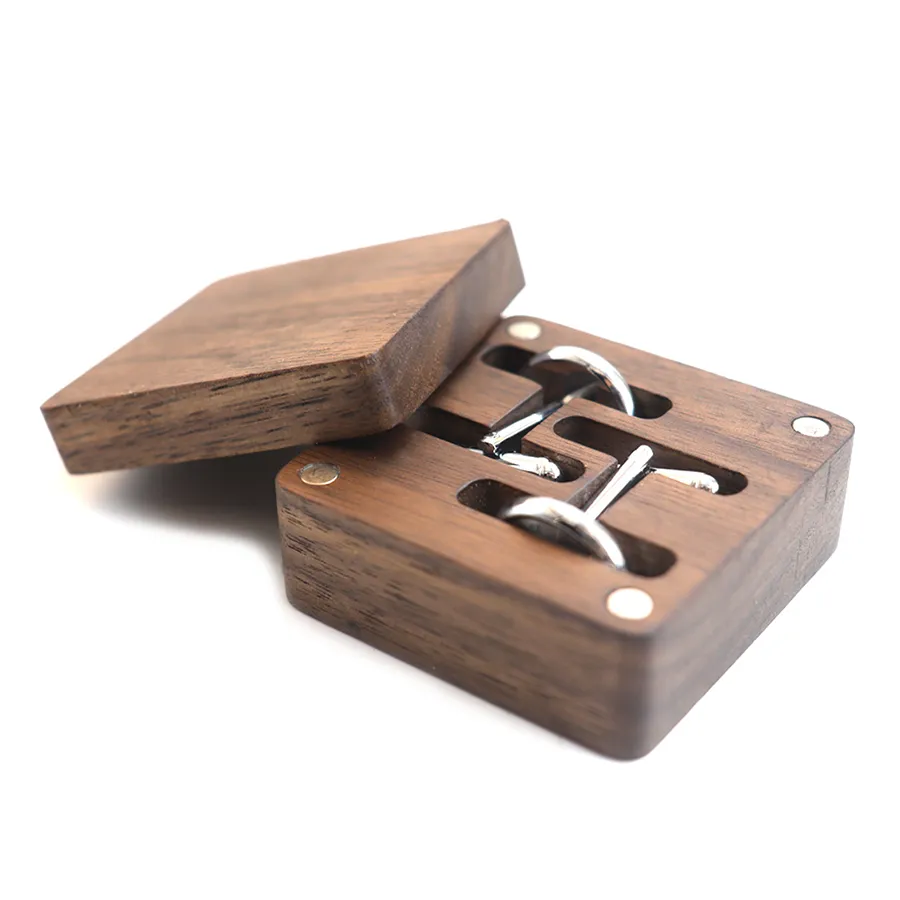
For most gift boxes we use N42 magnets in 8 mm diameter. For larger or heavier lids we step up to N48 or use multiple magnets per closure. Magnet cost is trivial ($0.04-0.10 per box) but the difference in feel is enormous.
A small but important detail: magnets need to be installed with the correct polarity. Reversed-polarity installation will repel rather than attract. We test every magnetic closure during pre-shipment QC.
Locks
Surface-mount brass key lock
Traditional, visible, gold-tone. Brass body with brass key. The classic look for jewelry boxes, document boxes and stash boxes. Comes with two keys per lock as standard.
Cost: $0.60-1.40 per lock.
Recessed cam lock
Hidden inside the box wall, only the key entry is visible from outside. Clean exterior, premium feel. Used in concealed-construction watch boxes and document chests.
Cost: $0.80-1.80 per lock.
3-digit combination lock
No key to lose. Customer sets a 3-digit combination. Industry standard for stash boxes and travel humidors. Available in brass, satin nickel and matte black.
Cost: $1.20-2.40 per lock.
For premium products we recommend brand-stamped keys — about $0.20-0.30 per key extra to engrave brand initials or a logo. Customers notice this within seconds of opening the box.
Clasps and latches
Hook-and-eye clasp
Traditional craft look. A small brass hook on the lid catches a brass eye on the box front. Often used as a decorative accent rather than a primary closure (paired with a magnetic closure inside).
Swing latch
A pivoting brass arm that swings into a catch. More secure than hook-and-eye, vintage gift box look. Common on wine boxes and heritage gifting.
Hasp and padlock
Industrial / security look. Used for security boxes and travel-grade humidors where additional locking is required.
All clasps available in polished brass, antique brass, chrome and matte black.
Pulls, knobs and handles
- Brass cup pulls — for drawer boxes (~$0.40-0.90 each)
- Mushroom knobs — for dresser-style cabinet boxes (~$0.30-0.70)
- Recessed finger pulls — for clean exteriors with no visible hardware (~$0.25-0.55)
- Leather strap handles — for crate-style boxes (~$0.80-1.50)
- Rope handles — for rustic outdoor boxes (~$0.35-0.70)
- Stainless steel bar handles — for kitchen products (~$0.60-1.30)
A note on quality grades
Hardware costs are low per-unit but accumulate quickly across an order. Quality grades vary widely. There are essentially three tiers:
Tier 1: Generic Chinese hardware
Cheapest option. Acceptable for low-volume budget products. Plating may dull within 6-12 months. Operating mechanisms may stiffen. Standard for products at the $5-20 retail price tier.
Tier 2: Mid-grade Taiwanese / branded Chinese
What we use as default for most ODM and ODM-plus products. Significantly better plating durability and tighter operating tolerances than Tier 1. Adds about $0.20-0.50 per box across all hardware combined.
Tier 3: German Häfele, Blum, or Italian Salice
Premium European hardware. Soft-close mechanisms that stay smooth after 50,000 cycles. Plating that holds up to decades of handling. Adds $1.00-3.50 per box. We recommend this tier for products positioned at $100+ retail or for heritage / heirloom projects where the box is meant to last decades.
A buyer's checklist
- Always specify the hinge type and finish in writing — do not leave it to the factory default
- For magnetic closures, specify the magnet grade (N35, N42, N48, N52) — not just "magnetic"
- Test 50 open-close cycles on every sample before approving
- For premium products, request Tier 2 or Tier 3 hardware by name in the quote
- Include hardware in the spec drawing, not just in a description paragraph
- Verify all locks come with at least two keys, and that key blanks are available for replacement
How hardware actually fails — and how to spot it early
Hardware failure modes are predictable. Most failures fall into one of four categories, and most are visible during sample inspection if you know what to look for.
1. Plating failure on cheap hardware
Tier 1 brass-plated hinges and locks have plating that is essentially a thin layer of brass color over base steel. With handling, the plating wears off at high-friction points (pivots, key entry, knob centers) revealing the base metal underneath. Visually unmistakable — the hardware develops "bald spots" within 6-18 months of normal use.
Spot check on samples: rub a fingernail firmly across the hinge surface and across the screw heads. If the surface marks easily, the plating is thin. Solid brass and Tier 2/3 plated hardware will not mark.
2. Hinge sag from over-torqued screws
Cheap installation crews over-tighten hinge screws to compensate for poorly cut mortises. The wood fibers around the screw compress; over time the screw loosens; the hinge sags; the lid no longer sits flat.
Spot check on samples: open and close the lid 50 times, then check whether it still sits flat in the closed position. If the lid develops any forward droop, the hinges or installation are inadequate.
3. Magnet polarity reversal
Cheap installation skips polarity testing. Reversed-polarity magnets repel rather than attract — the lid pushes itself open instead of snapping closed.
Spot check: every box should have its closure mechanism tested at final QC. If you find even one reversed-polarity unit in a sample run, demand a 100% inspection of the production line.
4. Lock cylinder failure
Tier 1 cam locks and combination locks use stamped metal pins and weak return springs. Pins bend, springs lose tension, the lock either jams or stops engaging properly within a year of regular use.
Spot check: cycle the lock at least 30 times during sample inspection. If you feel any grit, hesitation or sticking, the mechanism is undergrade.
When to upgrade — the cost-vs-quality math
Hardware is one of the most leveraged upgrades in a wooden box. Upgrading a single hinge from Tier 1 to Tier 2 typically adds $0.20-0.40 per box. Upgrading the entire hardware spec from Tier 1 to Tier 3 (premium European) adds $1.50-3.50 per box.
Three rules of thumb for when the upgrade is worth it:
- Retail price tier — at $40+ retail, hardware quality starts to define the brand impression. At $100+ retail, premium hardware is essentially mandatory.
- Use frequency — products that get opened daily (kitchen, jewelry, watch storage) wear hardware fastest. Use frequency × years of expected ownership = total hardware cycles. Above 5,000 cycles, upgrade pays for itself in failure avoidance.
- Brand positioning — heritage / heirloom / premium positioning requires hardware that visibly justifies the position. Cheap hardware on a premium-positioned product reads as "they cut corners somewhere," which damages the entire brand impression.
Frequently asked hardware questions
Can I supply my own hardware?
Yes — many higher-volume buyers do exactly this. Source the hardware separately, ship it to our factory in Cao County, and we install it. The complication is timing: hardware needs to arrive at our factory at least 5 days before production start, with documentation matching the production order. For first-time buyers we usually recommend our hardware first; once the relationship and process are established, customer-supplied hardware is straightforward.
How many spare keys should I include?
Standard is 2 keys per lock (one main, one spare). For high-end products we recommend 3 keys: 2 for the customer plus 1 for branded packaging display in the retail box. Adding extra keys costs about $0.10-0.20 per key.
Do magnetic closures interfere with watches or electronics?
In theory yes; in practice almost never. The neodymium magnets we use are weak compared to anything that would meaningfully magnetize a watch (consumer wristwatch tolerance is around 60 gauss; our N42 magnets generate field strengths well below that at 1cm distance). For storage of vintage mechanical watches with very low magnetic tolerance, we can spec non-magnetic closures (latch or hidden hook) instead.
What is the lifetime of a properly specified hinge?
A Tier 2 concealed European hinge with soft-close mechanism is rated for approximately 80,000 open-close cycles. At 5 cycles per day (heavy use), that is 40+ years. Tier 3 German Häfele or Blum hinges are rated for 200,000+ cycles. Tier 1 hinges are typically rated for 5,000-10,000 cycles, which is roughly 3-5 years of daily use before noticeable wear.
Are stainless steel hinges always better than brass?
Stainless steel is more corrosion-resistant (relevant for kitchen and bath products); brass is more visually warm and traditional (relevant for premium gifting). Choose based on the use environment and the brand voice. Both have premium versions.
Hardware is the part of a wooden box that gets used the most and specified the least. Spec it like it matters — because the hinge that fails in month seven becomes the one-star review that sticks for years.
For first-time buyers, we recommend doing one round of sampling specifically focused on hardware. Order three samples of the same box with three different hardware grades — Tier 1, Tier 2, Tier 3. Open and close each one a hundred times. Feel the difference in your hand. The choice that feels right to you is almost always the one your customer will respond to. The hardware is a small percentage of the cost; it is most of the perceived quality.